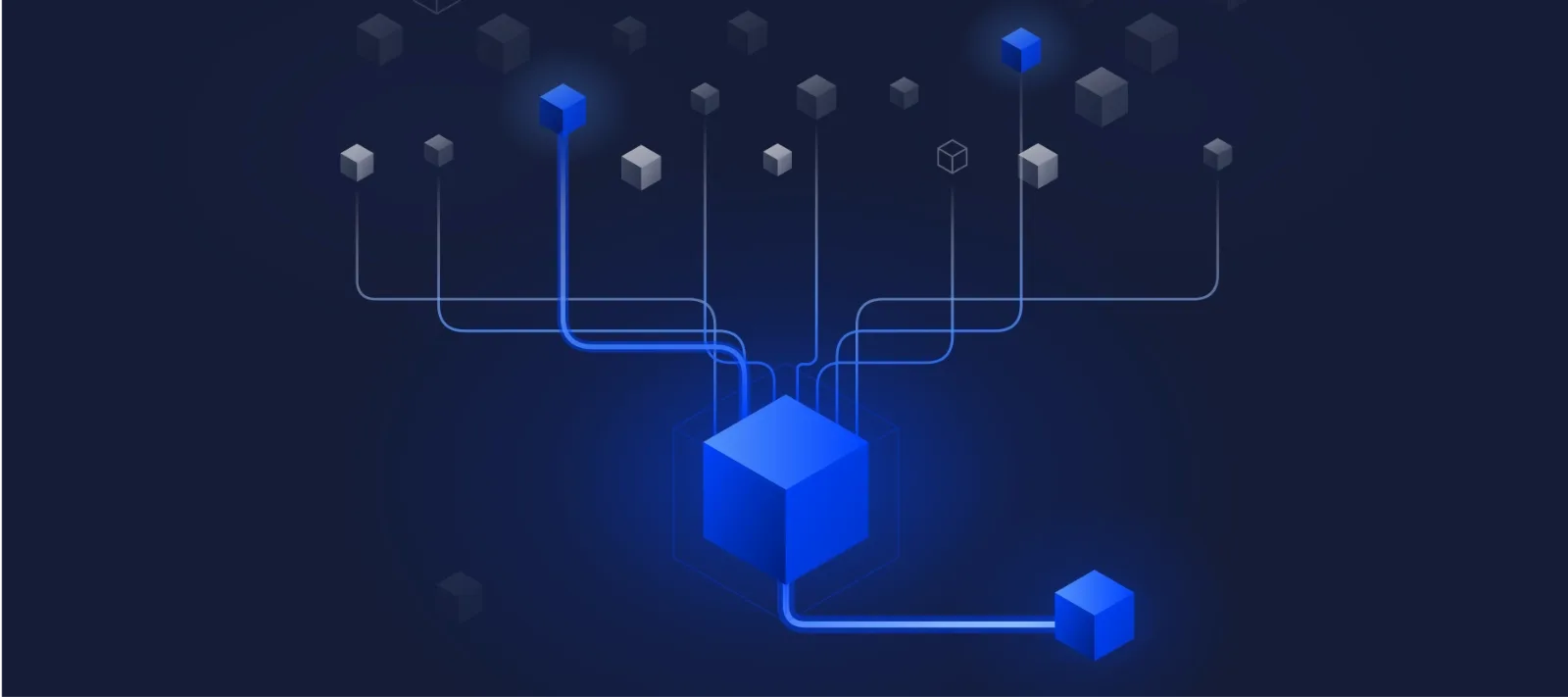
AI & the 100x network
What if the biggest user of your network isn't a person at all? Not your developers, not your video calls, but a swarm of AI agents firing off hundreds of requests on behalf of one user who typed a single prompt.
That's the transition we covered in our latest webinar, hosted by Rick Mur, CTO at GNX. Not AI as a buzzword, but AI as a traffic pattern. And if you're planning capacity the way you did five years ago, you might need to reconsider: a lot needs to change about how you look at your own network.
In short, this is what we learned:
The internet's biggest user isn't human anymore
The statistic that triggered this webinar: 53% of all internet traffic is now automated. Machines officially overtook humans on the network we built for humans.
A big driver is LLMs crawling and indexing the web. That traffic grew by just shy of 200% in a single year. And here's the uncomfortable part: chatbots and agentic AI still account for less than 2% of internet traffic today. So the big wave we are talking about is barely hitting your network.

One task, 44 websites, 450% more traffic
This is where it gets concrete. Rick highlights a Cisco report that gave the same task to a human and to an AI agent. The human opened a handful of pages. The agent pulled in 44 sources and generated 450% more network traffic.
Rick's own example from the day before the webinar: one report, one prompt, and the application spun up 12 agents pulling from data sources simultaneously. Where you'd open five tabs to compare prices, an agent visits hundreds of sites at once.
Here the point isn't the megabytes. It's the sessions, the concurrency, and the fact that all of it has to pass through the same firewalls and inspection points you sized, initially, for people.
Where your current design breaks first
The middle part of the session maps this to network design. What’s changing?
- Upload enters the requirement list. Regular web browsing is about 0.5% upload. With AI applications, that climbs toward 9% of bandwidth. This means sizing your links on download speed alone is no longer enough.
- Sessions multiply and linger. Agent flows stay open around twice as long as human browsing, and there are far more of them. Firewalls, NAT tables, and SASE capacity sized for human click-and-leave behavior will feel it first.
- The middle mile becomes a latency tax. Cloud security inspection means your traffic detours through a SASE pop before it reaches anything. Multiply the sessions by ten and your local provider's peering into that pop matters more than the headline bandwidth on the circuit. (This is exactly the kind of data GNX+ surfaces: real provider performance, not marketing promises)
- The attack surface widens. More sessions, longer-lived flows, and more data shared with LLMs than ever left your perimeter before. Security inspection isn't optional.
Upcoming webinar: Agentic sourcing, and the network it buys
24 September, 2026 | 9:00 AM ET / 3:00 PM CEST
You can't cache your way out of this
Back in the day, video streaming faced its own capacity crisis. In our webinar, Rick explains how Netflix solved this by pushing racks of servers into local ISP networks. 80–90% of traffic ended up served from nearby caches.
Hard to apply to AI, though.
AI is not cacheable. Like live sports is not cacheable.
Every prompt is unique to the user asking it. Edge compute and local models will bring inference closer and shave the per-query cost, and frontier AI companies are already building out regional infrastructure, but distribution helps; it doesn't fix.
Build for the machine era
Cisco research projects roughly a 10x increase in enterprise network traffic by 2035. And 80% of executives are betting on their companies using agentic AI in a big way by next year. So we are not talking long-term, but your next renewal cycle.
The lesson from this webinar isn't "buy more bandwidth." It's that AI changes how networks are used: more upload, more sessions, more sensitivity to latency and peering. Your connectivity decisions should reflect that.
That's what GNX is here for: strong relationships and local know-how in 190+ countries, real performance data instead of sales promises, and a carrier-neutral platform that lets you design, compare, and quote your connectivity yourself in minutes. A network that's ready for its new users (including those that are not human).
Get in touch
Watch the full recording above or get in touch to discuss your network transformation project. We’ll be happy to help.

Speaker: Rick Mur
Rick is the Co-Founder & CTO of GNX. With a deep background in network infrastructure, software development, and telecommunications, Rick has been at the forefront of optimizing and automating global connectivity solutions for enterprises.
As a technology leader, Rick is passionate about scalability, automation, and digital transformation in the telecom industry. He has extensive experience in architecting resilient networks, leveraging cloud-native technologies, and driving data-driven decision-making in network operations. Rick is known for his clear way of explaining technology, his strong product instincts, and his passion for improving an industry that has long been difficult to navigate.