
Rethinking your global internet sourcing and procurement strategy

What if the installation lead time you were just quoted could be cut in half, not by pushing harder, but simply because someone else already did the relationship-building for you?
That's not a hypothetical. It's what happens when a connectivity partner has ordered from that same local ISP dozens of times before. And it's one of the least talked-about differences between sourcing internet vendors in-house and doing it with a global connectivity expert.
But let's rewind first, because internet sourcing didn't used to be this complicated.
From MPLS to internet access - when did global internet sourcing get so complex?
Blame progress. No joke.
In the MPLS era, you signed with one global carrier and lived inside a tidy, closed ecosystem. One vendor, one contract, one throat to choke. The service was more expensive, not easy to change, but procurement was simple.
Then the shift happened. Cloud-first applications, SD-WAN, and hybrid work made local internet access the smarter underlay for most sites. It was also cheaper – both for setup costs and monthly rates.
But there's a trade-off: instead of one MPLS provider, you're now dealing with an entire telco ecosystem. As GNX CEO Rutger Bevaart put it on the TeleGeography Explains the Internet podcast: is sourcing across "20, 30, 40 countries in different currencies with different rates, contracts, languages, support methods" really something you want to get engaged with?
For many procurement teams, the answer arrives about six months in.
The DIY trap: common pitfalls of in-house global internet sourcing
On paper, sourcing local vendors yourself looks like the lean option. No middleman, direct pricing, full control. In practice, four things tend to go wrong.
One person, too many time zones
Most organizations won't hire a full procurement team just for connectivity. It's a fraction of their spend. So the job lands on one person, in one location, negotiating with ISPs across the Americas, Europe, APAC, and MEA. Every quote request, every follow-up, every escalation crosses a time zone and often a language barrier.
In a DIY model, you might have one procurement person in one location, because you won't hire a proper team only for connectivity sourcing. Instead, global internet aggregators often have dedicated procurement and provisioning teams with local expertise and built relationships for each region.
Eda Guven - Chief Procurement Officer, GNX
The local rules nobody tells you about
Every country has its quirks, and vendors don't always volunteer them upfront.
In Tunisia, specific documents are required from the end customer before an order can even be placed. In Switzerland, you can't proceed with ordering without providing a local electrician contact. There's no "global manual" on dealing with local internet access, and any of these can stall your delivery for weeks if you learn about them the hard way.
Regulations regarding the purchase or installation of internet access will vary per country. Even if a new vendor doesn't mention these requirements at the beginning, you should proactively check them. Based on real experience, at GNX, we can foresee issues a first-time buyer simply cannot be aware of, and those issues are what cause delays.
Eda Guven - Chief Procurement Officer, GNX
The time you didn't budget for
Searching for vendors, comparing offers using different terminology, validating claims, negotiating local terms... it all takes time your team doesn't have. And that's before onboarding: in large organizations, getting a single new vendor through legal, security, and finance can take months. Multiply that by every country you operate in.


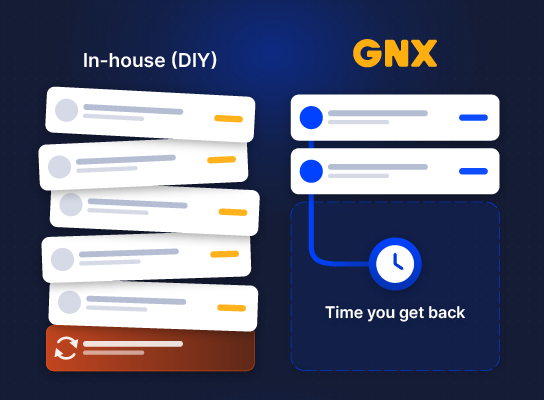
DIY vs GNX
Sourcing in-house may seem like the leaner option... but is it? This infographic takes you step by step through where you might be able to optimize resources and save time.
Starting every relationship from zero
A first order with an unknown vendor moves at the vendor's pace. There's no history, no leverage, no shortcuts. An aggregator that has already ordered from that ISP many times starts from a very different place: established contracts, known processes, and a relationship that has already absorbed the first-order friction. In many cases, that alone can cut the quoted lead time in half.
And when a location is served by an exclusive or difficult vendor? A global partner usually has other in-country relationships to buy that last mile through. A solo buyer might be left in the dark.
Questions to ask before you sign with a local vendor
Whether you source in-house or not, these questions will save you pain. And time.
- You're on-net — but who owns the fiber? Some vendors lease fiber from a third party and still call it their own last mile. If the fiber belongs to someone else, that matters, especially for diversity requirements.
- Is this a dedicated or contended service? This may be a terminology issue or lack of knowledge. What's important to recognize is that a residential-grade broadband with a business label won't carry your factory's uptime requirements.
- What does support actually look like? Is the help desk 24/7? In what language? Can your follow-the-sun IT team on another continent log a ticket at 3am local time?
- What do you need from us to place the order? Documents, site contacts, local requirements... get the full list before you commit to a delivery date.
- Do these two circuits share any infrastructure? If you're buying diversity, verify it at the physical level, not the logo level.
Every one of these answers affects your sourcing lead time and your sourcing quality. As Eda puts it: "Based on several real experiences, we know what questions to ask. A first-time buyer might not know that 'it's our own last mile' isn't always the case."
Tailwind: technology on your side
Here's the good news: tooling for global internet sourcing has caught up with the complexity.
Instead of spending time searching, emailing dozens of ISPs, and waiting weeks for quotes in different formats and currencies, platforms like GNX+ let you enter your site addresses and requirements and get easy-to-compare quotes from competing ISPs — instantly, in one view.
But that's not all. With GNX+, you can order in the same flow, track provisioning per site, monitor your live network, and manage changes and tickets across your whole WAN estate. If you'd rather work from your own systems, API and eBonding integration connects it to your existing procurement platform or ERP.
That changes what your team spends its time on: less chasing vendors for quotes, more deciding based on market data and transparent local insights.
Hi, we are GNX
Technology solves the visibility problem. Experience solves everything else: the Tunisian paperwork, the Swiss electrician, the "on-net" claim that isn't.
And that's what you can expect when working with a global connectivity expert like GNX:
- A global procurement and provisioning team with local know-how;
- Established relationships with 3,000+ ISPs across 190+ countries;
- and the accumulated expertise of thousands of orders.
Plus, all of these come wrapped into a single contract, a single invoice, and a single point of contact for support. The platform, GNX+, comes included, so your team keeps total control and full transparency without carrying the operational load.
You could build all of that in-house. The better question is whether you should, or whether your team's time is worth more spent on the decisions only they can make.
Keen to take a first step? Try our quoting demo for actual pricing on any of your sites.
Quote internet in seconds
Try GNX+ quoting feature by entering your site address and WAN requirements.
Hi, we are GNX
We work with 3,000+ local internet providers in 190+ countries so you dont' have to. Let's talk.