
We asked AI to quote global internet services. Here's what it got right, and what not.

Another Friday morning, another deadline. You've got a multi-country DIA brief on your desk, three quote requests still unsent, and a few Excel spreadsheets yet to compare. So when a colleague says "just throw it at the AI," you are very tempted.
For those in procurement who can relate to this scenario, we went and tried it first.
We gave an advanced LLM a procurement brief: Dedicated Internet Access plus diverse secondary circuits across 20 urban sites in seven countries. HQ in Oslo, sites scattered across Norway, Sweden, the Netherlands, Germany, France, plus one in Taipei and one in Singapore, and asked it to quote and come up with a selection of carriers and ISPs.
The result? Well, some of what came back was impressive. But as we continue to learn in this AI era, some of it was best taken with a grain of salt (meaning it would have cost us six figures and 18 months of pain).
Here’s our breakdown.
The experiment: feeding a multi-country DIA RFP into a frontier LLM
We tried making the brief as specific as possible: 100 Mbps to 1 Gbps DIA per site, depending on use, full BGP, /29 IPv4, IPv6, 99.95% SLA minimum, 4-hour MTTR, 36-month commit acceptable. Secondary circuits had to be physically diverse as much as possible, meaning different providers, different last-mile path.
Within 90 seconds, the model produced a 2,400-word sourcing memo. Country-by-country shortlists. Primary and secondary pairings. SLA commentary. MRC ranges per circuit. Install lead times. A risk-flag section. Even a suggested aggregate SLA structure.
Honestly? It looked good enough to call it a day. That was exactly the problem.
What it got right (credit where it's due)
- Structure was solid. Clean tables. Primary and secondary ISP per site. SLA columns, MRC range, install lead time. As a starting framework for an internal sourcing memo, it was usable.
- SLA explaining was sharp. It correctly flagged that 99.95% per site means roughly 4.4 hours of permitted downtime per circuit per year, and that without aggregated SLA language across the diverse pair. You can have a "compliant" carrier and still lose a quarter to outages (we covered that in this webinar).
- MRC comparisons were useful. The model knew Singapore DIA costs more than Frankfurt DIA. It knew Norway sits at the high end of the Nordic price band. It correctly placed Paris below Frankfurt and Singapore above Taipei. The relative ranking was right, even if the absolute numbers wandered.
- Obvious carriers showed up. Telenor and Telia in the Nordics. KPN in the Netherlands. Deutsche Telekom and Colt in Germany. Orange in France. Chunghwa Telecom in Taiwan. Singtel in Singapore. None of those are wrong as starting points.
The cautions: what it got wrong
But as a first-time experiment, we went back to check the job for our fellow procurement teams.
- Regulatory nuance was weak. It treated Taiwan as a generic APAC market. No mention of NCC licensing implications. No flag on cross-strait routing sensitivities. No acknowledgment that data flows between the Taipei site and the EU sites may have GDPR consequences, depending on which transit paths the carrier actually uses. Not considering these would impact lead times, as issues start to arise later in the project.
- Last-mile reality was completely fictional. The model assumed fiber availability everywhere in "urban" areas (we did that on purpose). It ignored that construction work was required for one street specifically. They'd have to backhaul via a wholesale partner, killing the SLA story and adding 6–8 weeks to install.
- Supplier viability got hand-waved. It cheerfully recommended a regional French altnet currently being absorbed into a larger group, meaning anyone signing a 36-month commitment today is signing with a logo that won't exist in six months. That detail isn't in the model's training data. It's in a press release from three weeks ago.
- Pricing was confidently wrong. The MRC ranges for our Singapore and Taipei sites were off by close to 40%. Asia DIA pricing has shifted over the last 18 months, and the model was using outdated wholesale benchmarks. In other words, the AI was overpromising savings to the CFO. By a lot.
- Diversity claims were unverifiable. The "physically diverse" secondary recommendations didn't account for the fact that two "different" internet providers often share the same wholesale fiber route into a building. The model couldn't see that.
The "explainability" problem for procurement
But this is what bothered us the most.
When asking the model why it recommended a specific pairing, it did what LLMs do. It produced a fluent and convincing paragraph. But none of it was sourced.
No audit trail. No "this carrier ranked here because their published SLA is X and their installed base in this metro is Y."
Anyone taking their job seriously knows this is a fail. Sourcing decisions need compliance frameworks, audit trails, and CFO scrutiny. A black-box recommendation is worse than no recommendation. After all, we are in this industry for a reason.
The root problem here isn’t the AI. It’s that the model had no access to verified, real-world market data. It was reasoning from publicly available information, averaged and already out of date. That’s not an AI problem. That’s a data problem.
Our conclusion: it’s not AI, but data and expertise
What the LLM lacked wasn't intelligence. It lacked current, structured, verifiable market data (the kind that only comes from years of operating in this market, not from scraping the internet), and a human (you!) who's actually negotiated a Taipei DIA contract before.
That winning combination still holds up.
A real sourcing decision needs three layers.
- Live market data on what carriers and ISPs are actually quoting this quarter, not last year's averages.
- Last-mile intelligence: does this carrier have on-net presence at this address, or are they reselling someone else's fiber? Are these two providers sharing a pipe or is it actually a diverse link?
- And expert review from someone who's seen and understands the regulatory and contractual weirdness specific to the country in question.
LLMs are powerful. But without the right data, they are working blind. That’s the gap.
How GNX+ combines proprietary data, AI, and human expertise
This is where GNX changes the math.
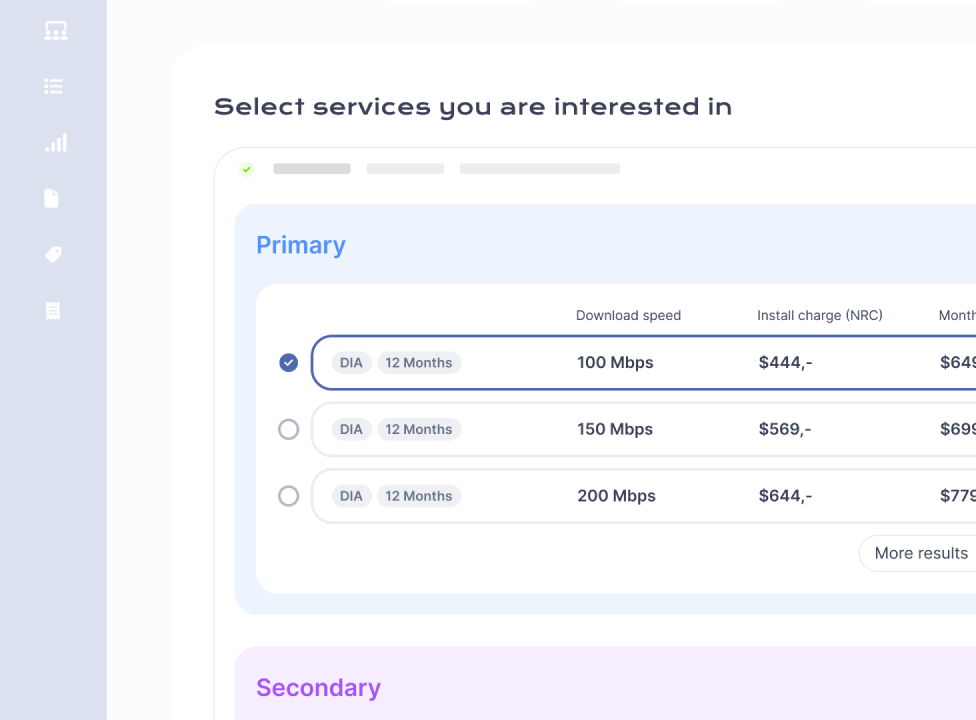
Our proprietary carrier-neutral platform, GNX+, pulls live carrier pricing, on-net coverage, and SLA performance into one place. Not from data on the internet, but procured and vetted by our own teams and long-standing relationships with thousands of ISPs.
Then, GNX+ applies machine learning and automation to over seven years of proprietary market data — pricing, coverage, SLA performance, and supplier track records — built from real transactions, not public sources. That’s what makes the output verifiable and auditable, in a way a general-purpose LLM simply cannot be.
So when you're shortlisting internet providers for a Stockholm site, you're seeing who actually has fiber to that postcode, what they've quoted other GNX customers for similar circuits in the past, and how their SLAs have performed against contract. Current data. Verified data. From the market, not the internet.
But the platform isn't where it ends. We’ve sourced and reviewed these quotes ourselves. We understand the regulatory issues and help you navigate them. We know which ISP is mid-acquisition. We know that the Taipei building you're moving into has only two genuine on-net carriers despite four claiming coverage.
And you get it all when working with us.
Local market insights and human review. Total control plus expert backup. That's the combination procurement teams actually need, and the AI experiment made painfully obvious why neither half works alone.
So, would we do it again?
As a brainstorm partner, yes. LLMs are great at structure, framing, and surfacing the obvious shortlist. Not so great at the things that actually matter when the contract gets signed.
Discover GNX+
GNX+ uses data, machine-learning and automation to support your connectivity decisions and your teams throughout the entire lifecycle. If you haven’t seen it yet, we’d love to show it to you in a live demo using your existing sites.
We are a global provider of internet connectivity, here to change how you source and manage global networks – making it transparent and straightforward.