Type 1 vs type 2 access: who really owns your last mile?

When quoting sites in the US, the smallest label on a US connectivity quote often matters most: Type 1 or Type 2. They tell you whether the provider you sign with actually owns the cable into your building, or rents it from someone else.
That difference shapes how fast your circuit goes live, what it costs, how quickly a fault gets fixed, and whether your backup line is really a backup. Yet it rarely appears in the headline of a quote, and many buyers never ask.
It’s not like one is better than the other – what matters is that you know which one you are getting, what that means, where the trade-offs sit, and which questions to ask before you sign.
What Type 1 and Type 2 mean
Type 1 and Type 2 are US carrier shorthand, not a formal standard. Both describe one thing: who owns the last mile, the final stretch of network between the provider's backbone and your building.
- Type 1 access (on net). The provider delivers the circuit over its own facilities, end to end. Its fiber enters your building, its equipment sits in your comms room, and its own NOC can see the whole path. When something breaks, one company owns the problem.
- Type 2 access (off net). The provider does not reach your building. It buys the last mile wholesale from another carrier, typically the incumbent telco (ILEC), a competitive carrier (CLEC), a cable operator, or a regional fiber company. That carrier hands the traffic over to the provider at an interconnect point (NNI). You sign 1 contract, but 2 networks carry your traffic.
- Near net sits in between. The provider has fiber close by and can build a short lateral into your building. Once built, the circuit becomes Type 1, but the construction adds cost and lead time to the first order.
Neither type is good or bad by default. In much of the US, Type 2 is the only way a national provider can reach a given address. The point is to know which one you are buying, because it changes what you can expect.
How a Type 2 circuit is built
A Type 2 circuit is 2 services stitched together at a handoff point (NNI), and that handoff is where most of the tradeoffs come from.
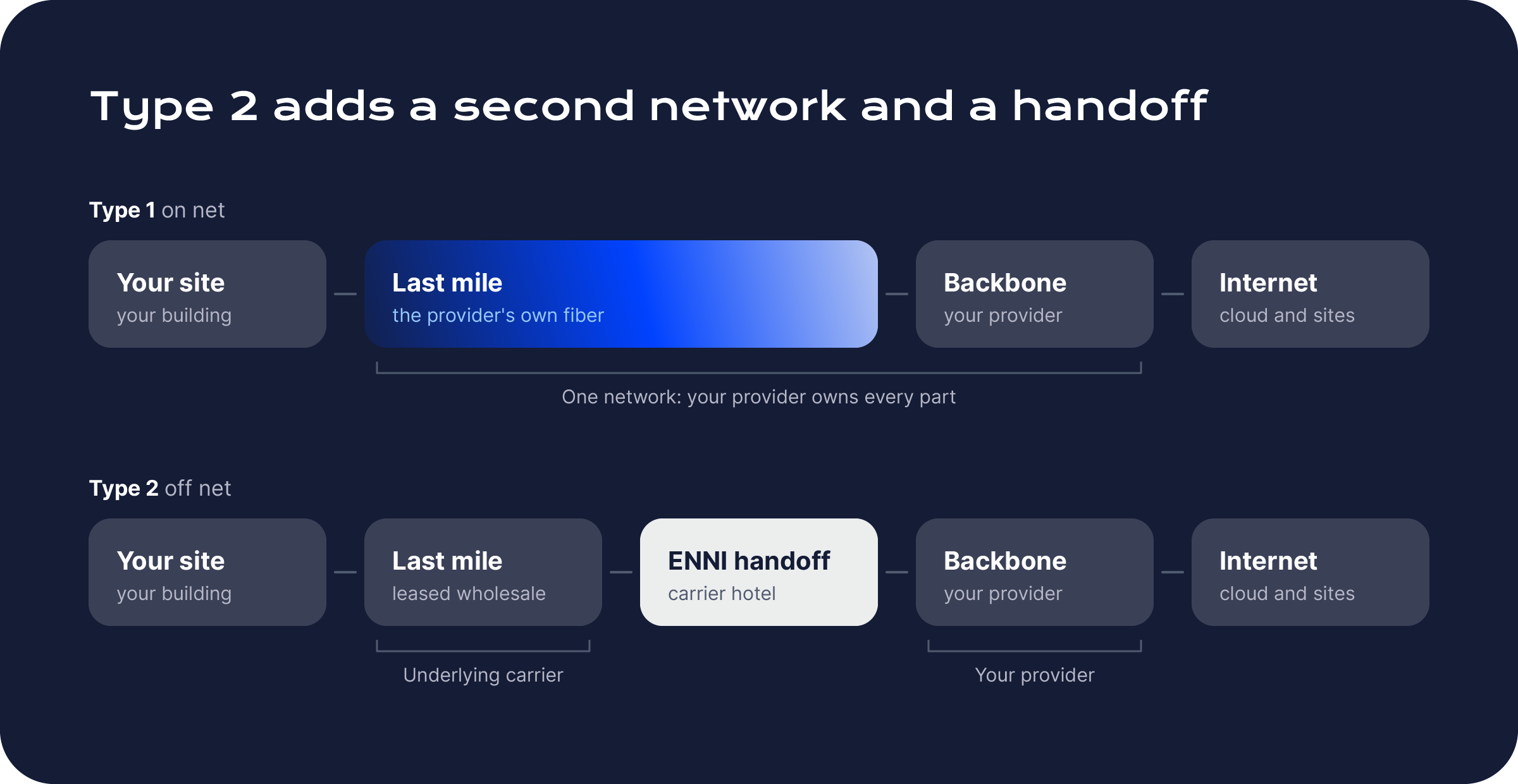
On a Type 2 circuit, another carrier owns the last mile, and your traffic crosses an ENNI (External Network-to-Network Interface) before it reaches your provider's network.
- The last mile. The underlying carrier delivers a wholesale access circuit from your building to one of its aggregation sites. For Ethernet services, the industry body MEF calls this wholesale piece an E-Access service.
- The interconnect. At a shared data center or carrier hotel, the underlying carrier hands traffic to your provider over an NNI, called an ENNI for Carrier Ethernet. One high-capacity port carries many customers, each separated by its own VLAN tag.
- The provider's network. From the ENNI onward, your provider carries the traffic over its own backbone to the internet, to your other sites, or to a cloud on-ramp.
Your provider manages the relationship, the contract, and the bill. But it does not control the fiber, the field technicians, or the repair queue on the last mile. Those belong to the underlying carrier.
Where the difference shows up
On paper, a Type 1 and a Type 2 circuit can look identical: same bandwidth, same SLA, similar price. In operation, they behave differently.
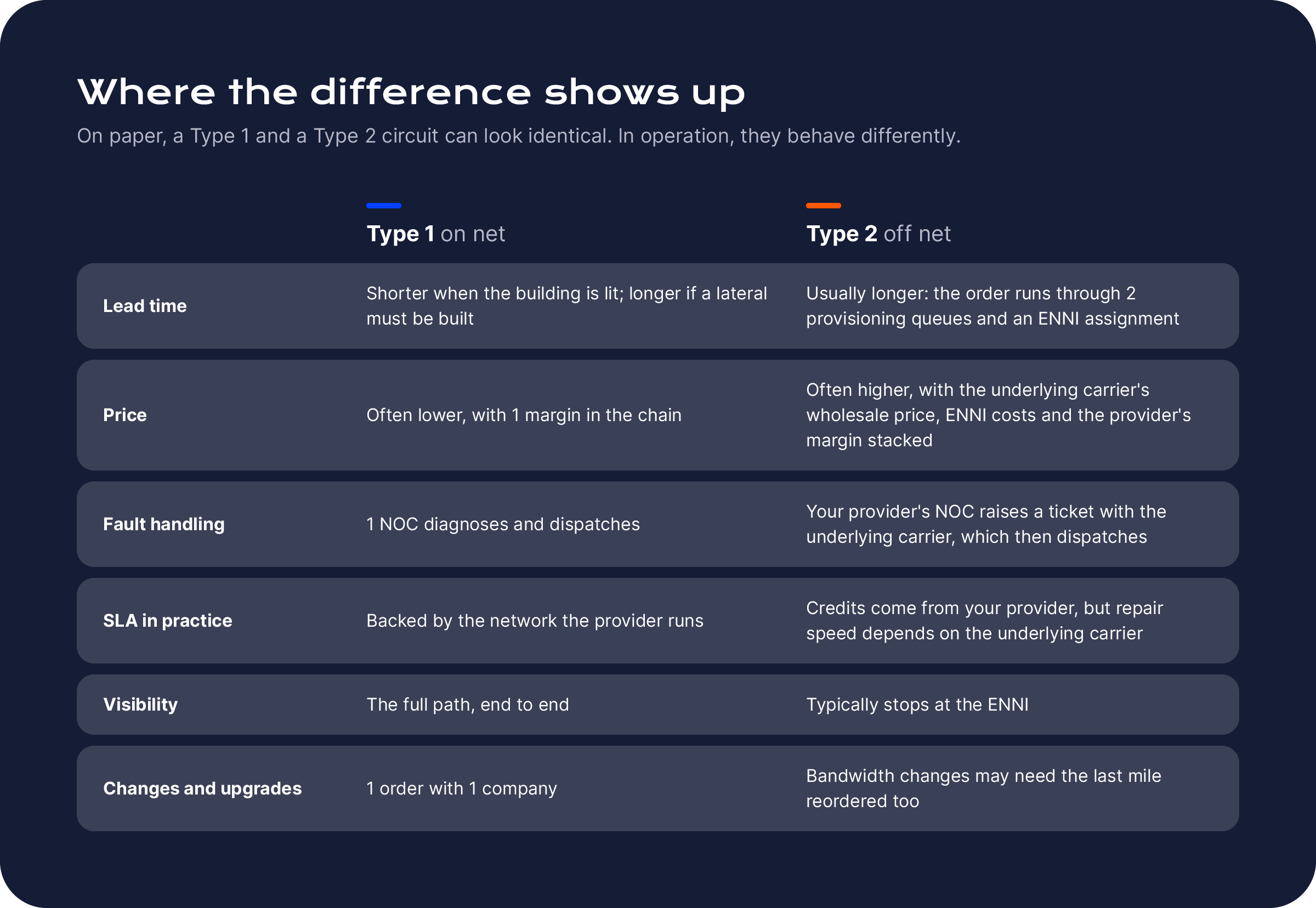
- Lead time. A Type 2 order waits for the underlying carrier to accept, schedule, and install its part, and for both sides to configure the ENNI. Each handover adds days. If the underlying carrier needs construction, its timeline drives the whole project.
- Cost. Type 2 is not always more expensive. Large providers buy wholesale access at volume and can be competitive. But when 2 quotes are close in price, the Type 1 option often carries more operational value for the same money.
- Fault handling. This is where buyers feel the difference most. On a Type 2 circuit, your provider can confirm the fault sits on the last mile, but it cannot send a technician. It opens a ticket with the underlying carrier and waits in that carrier's queue. Escalation runs through 2 organizations, and the clock keeps running.
- SLA. Your contract SLA is with your provider, and the provider pays any credits. But its real ability to meet a repair target depends on what the underlying carrier commits to. A 4-hour MTTR on paper means little if the wholesale tail behind it carries a weaker commitment.
The diversity trap
The most expensive Type 2 mistake is a backup line that fails at the same moment as the primary.
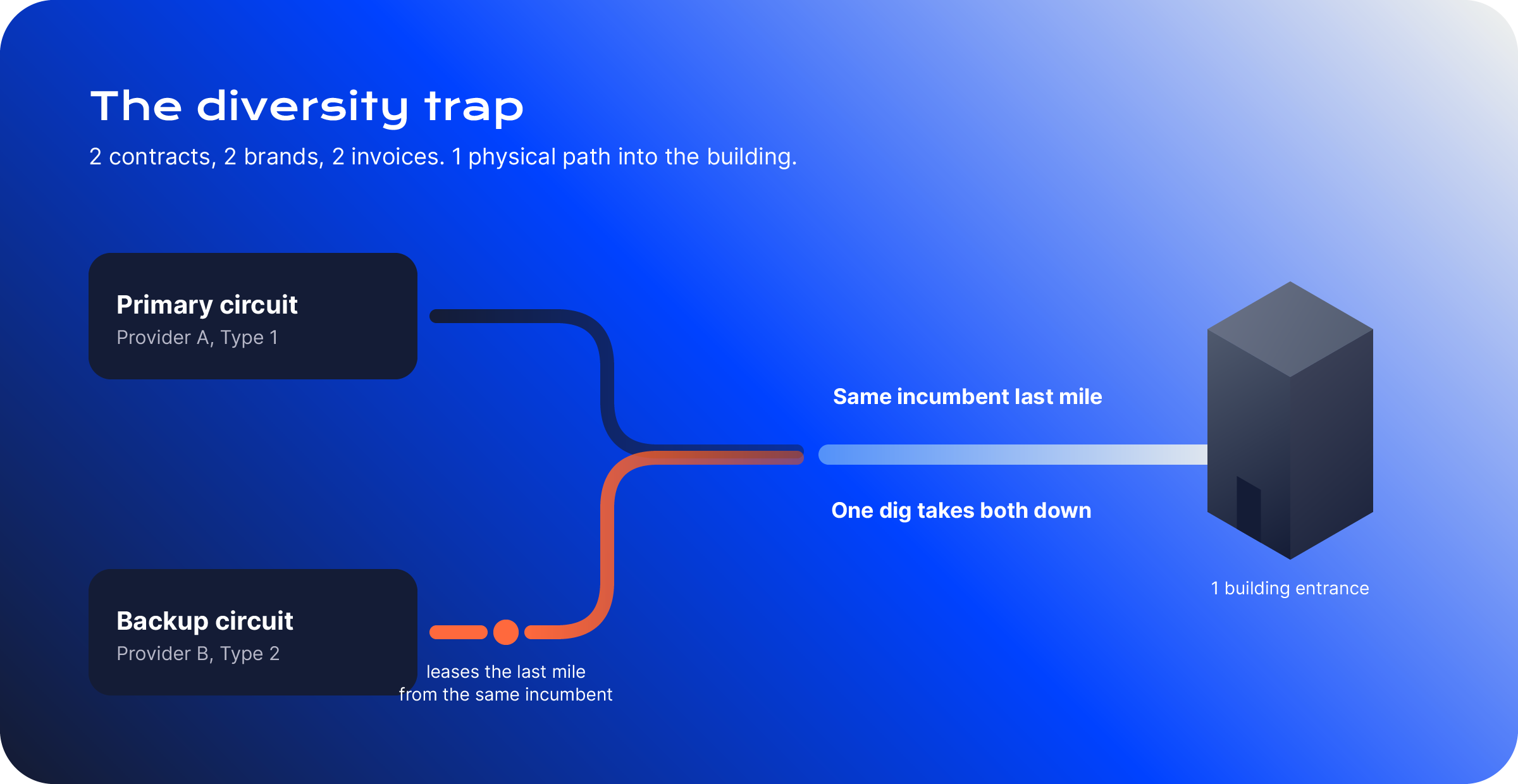
It happens like this. A site takes its primary circuit as Type 1 from the local incumbent. For resilience, it orders a second circuit from a different national provider. That provider is off-net at the address, so it buys the last mile from the same incumbent.
The result is 2 contracts, 2 brands and 2 invoices, riding 1 physical path into the building.
A single dig in the street, a flooded manhole, or a fault at the building entrance now takes both down. The redundancy existed only on paper.
The same risk applies between two Type 2 circuits from different providers that both lease from one carrier. Even two Type 1 circuits can share a conduit in the street or a single building entry point.
Real diversity is about the physical route, not the logo on the contract.
To avoid it, ask every provider for the underlying last-mile provider on each circuit, and for route maps where diversity matters. Compare entrance facilities, not just carrier names.
Type 3 and longer chains
Some providers use Type 3 for a circuit that is resold more than once. A reseller buys a Type 2 circuit from a provider, which in turn buys the last mile from an underlying carrier. Each layer adds a margin and another ticket queue.
Longer chains are not always avoidable, especially in remote locations. But every extra layer makes 3 things worse: price transparency, repair speed and the chance that anyone in the chain knows who actually owns the fiber. If a quote cannot tell you the underlying last-mile provider, treat that as a signal in itself.
Questions to ask before you sign
A few direct questions turn a vague quote into one you can compare like for like.
- Is this circuit Type 1, Type 2 or near net at this exact address?
- If Type 2, who is the underlying last mile provider?
- Where does the handoff to your network happen, and how is that ENNI protected?
- What repair commitment does the underlying carrier provide, and how does it align with the SLA and MTTR you provide me?
- Who dispatches a technician to my site when the last mile fails?
- For a diverse pair: do both circuits use different last-mile providers, different conduits, and different building entrances? Can you share route maps?
- If I upgrade bandwidth later, do I need to reorder the last mile?
A provider that answers these quickly and plainly is usually one that will also handle a fault quickly and plainly.
How GNX looks at it, and where the market is heading
As an aggregator of 3,000+ ISPs, GNX sees Type 1 and Type 2 quotes side by side every day. Our view is simple: the access type is a fact about the circuit, and the buyer deserves to see it.
That is why GNX+ treats the last mile provider as its own piece of information, separate from the ISP that delivers the service. When 2 options share 1 physical path, you should see that before you order, not after the first outage.
Where we can, we source from the provider that owns the last mile, which keeps the chain short. As prime contractor, we take ownership of the whole chain: one contract, one invoice, and a 24/7 NOC that chases the underlying carrier for you.
Looking ahead, 3 shifts will make access type easier to manage:
- Automated wholesale ordering. MEF's LSO Sonata APIs let operators quote and order off-net access from each other by machine instead of by email. As adoption grows, Type 2 lead times and quote turnaround will shrink.
- Access type as data. Access type, last mile provider, and entrance facility will become standard fields on every quote, so diversity checks can run automatically instead of relying on someone asking the right question.
- Underlay quality for SD-WAN and SASE. Overlay networks route around a bad link, but they cannot route around two links that share one cable. As more enterprises run SD-WAN and SASE, the physical diversity of the underlay becomes the foundation of the whole design.
Type 1 or Type 2 is not a verdict on quality. It is crucial information. The buyers who ask for clarity get faster delivery, fewer surprises, and backup lines that actually back them up.
We are here to change how enterprises source and manage global connectivity, making it transparent and more straightforward.